About Kashi
KAILĀSA Paramparagatha Kāshi
Sarvajnapeetha
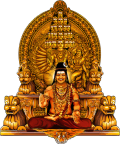
The KAILĀSA Paramparagatha Kāshi Sarvajnapeetha was established by Paramaśiva Himself as Kāshi Vishvanath in the sacred city of Kāshi, also known as Varanasi. From Paramaśiva, this lineage was passed down to Devi Jagadhatri, one of forms of Devi Paraśakti when she lived on Planet Earth. Over the course of thousands of years, the sacred lineage and the great city of Kāshi have been protected by Paramaśiva Himself, and safeguarded by countless sanyasis and brave kings and queens who gave their life for defending this tradition. Known as the eternal city, The Kāshi Sarvajnapeetha has proliferated the knowledge
tradition of Vedanta, consisting the Prasthana Traya, the three most studied scriptures in Hinduism – the Upanishads, the Bhagavad Gita, and the Brahma sutras. The Supreme Pontiff of Hinduism Bhagavān Nithyānanda Paramashivam, as the current successor of the Kāshi Sarvajnapeetha has not only spread this knowledge tradition but has made it easily accessible for the masses. It also bears deep significance in the life of the The SPH as the very place where He had the profound death experience and is now dedicated to the revival of the Science of Liberating Souls.
Origins
11,400 BCE
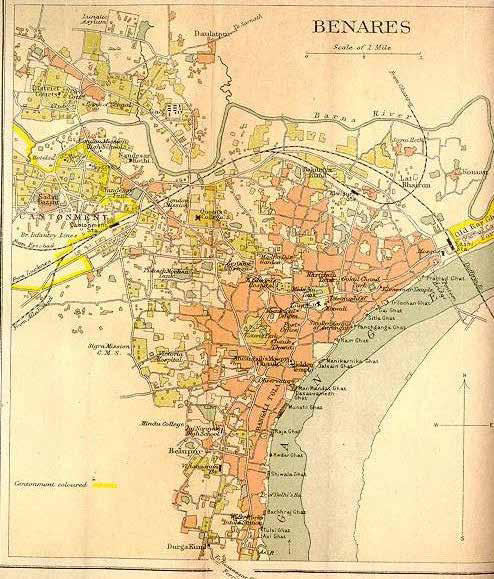
The city of Kāshi is one of the most ancient cities on Earth itself, remarkably still alive and thriving until today. Because of the brave warriors of Hinduism and the protection of Paramaśiva Himself, it has survived more than 11,000 years. The city in its core is as alive today as it was millennia ago, still a vibrant hub for spiritual seekers across the globe.
Kāshi is also known as Varanasi or Banaras. It is a city established by Paramaśiva himself and ruled over by kings of the Chandra Vamsa and Surya Vamsa. It is therefore a hub for the pantheon of Hindu tradition and is today being revived by The SPH through the Kāshi Sarvajnapeetha. Kāshi is the eternal city, which Paramaśiva declared will always be protected even during the time of deluge.
Skanda Purāṇa,
Kāshi Khanda 2nd verse
भूमिष्ठामि न यात्रभूस्त्रिमिवतोप्युच्चैरधः स्थामि या या बद्धा भुमव िुस्त्रििास्युरिृतं यस्यां िृता जंतवः ।।
या मनत्यं मत्रजगत्पमवत्रतमिनी तीरे सुरैः सेव्यते सा काशी मत्रिुराररराजनगरी िायाििायाज्जगत् ।। २ ।।
Even situated on Earth it is disconnected from it and even connected with the Upper Lokas it is situated in the lower Lokas, the City of Kāshi provides salvation to all the Lokas even while it is set up in the ‘Panchabhoutika’ Bhu Loka, whose dead persons attain divinity since Kāshi Nagar is Maha Deva’s Capital, where Sacred Ganga flows Always.
Hindu Heroes
In one account of extraordinary bravery, to protect the deity of Kāshi Vishvanath from Mughal invaders, 6 aghoris jumped into the well with the Śiva Linga. With the power of their yogic practice, they were able to retain themselves in a special state of samadhi, that would protect them and the Linga they jointly held above them while their home was being destroyed. Because of their courage, the Linga was recovered and restored in the temple.
Rani Ahalya Bai Holkar
Because of Aurangazeb’s terror over the city, the Kāshi Vishvanath temple was in ruins.. Rani Ahalya Bai rebuilt and restored the temple to its original glory
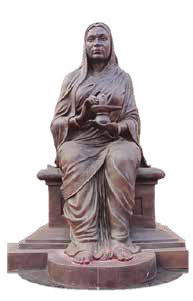
Statue of Rani Ahalya Bai Holkar at Kāshi Vishvanath temple, honored for her bravery and devotion in protecting Kāshi Vishvanath
Rani Lakshmibhai
During the Sepoy mutiny against the British empire, Lakshmibhai bravely fought to defend Hindu beliefs.
Kings and queens of Kāshi were still sovereign during the British Rule fought in powerful mutinies against the British.
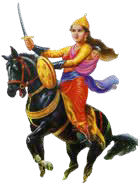
Rani Lakshimibhai in battle to defend the city
Though Kāshi is a spiritual nerve center surviving thousands of years until today, it is still just an echo of its glorious past. In the medieval era, the kingdom was barraged again and again each time rebuilding itself.
Annihilation of Hinduism
1136 CE
Qutub-ud-din-aibak desroyed 1,000 temples in the city.
1346 – 1496 CE
Feroh Shah of 1346 and Sikandar Lodi of 1496 were intent on annihilating Hinduism from the city
1700 BCE
Though there was a period of tolerance with the king Akbar, Aurangzeb besieged the city, looted and destroyed the temples again and ordered the construction of mosques in the place of Hindu temples.
Annexation of Kāshi
In 1948, Kāshi, a city revered for millennia as one of Hinduism’s holiest sites, was annexed into the Indian Union by Jawaharlal Nehru, India’s first Prime Minister. Hindus had endured countless persecutions over thousands of years, but with this act, they lost a sacred site that held immense spiritual significance for their faith.
2000, The SPH soon after being coronated as the successor of the Kāshi SJP
About Kashi Sarvajnapeetha
Established by Paramashiva Himself, Kashi Sarvajnapeetha is situated near the Manikarnika Ghat in Kashi-Varanasi, one of the most important sacred sthalas of Sanatana Hindu Dharma. Kashi represents all the five functions of Paramashiva and Parashakti – Creation, Maintenance, Destruction, Pulling out of Delusion and Liberation. Paramashiva blesses the world from here as Mahakala, Viswanatha, Annapurani, Jagadhatri, Tarakeshwar, Dakshinamurthy and in many other forms.
The Kashi Sarvajnapeetha is the most ancient university (Peetha) of all-knowledge (Sarvajna) which was physically established in the eternal city of Kashi at the Manikarnika Ghat by Paramashiva, Lord Vishwanatha Himself at the very beginning of time – Kala, and subsequently adorned by the greatest enlightened masters and incarnations including Lord Mahavishnu, Sage Vasistha, Sage Vyasa and Adi Shankara Bhagavatpada and is presently being graced by the living avatar of Paramashiva, the SPH JGM HDH Bhagavan Sri Nithyananda Paramashivam.
The Kashi Sarvajnapeetha is the ultimate seat of learning, the repository of all the knowledge of Sanatana Hindu Dharma and is verily the center of Hinduism. The Kashi Sarvajnapeetha is the superior apex body of Hinduism – the judicial collegium to decide and amend the standards of Sanatana Hindu Dharma. All decisions on Hinduism such as – who is enlightened, what the marks of enlightenment is, what is an authorized Bhashya, what is a Teeka, which is Shruthi, which is Smruthi, who is an Acharya, who is an Avatara Purusha, etc. are decided by the Kashi Sarvajnapeetha.
History of Kashi
Kashi is the oldest city in the world having been created by Paramashiva himself when he moved down from Kailash to be more accessible to the people of the world. When Daksha was beheaded in the Himalayas, humans had no leader – no king who could guide them – and hence at that time, Paramashiva himself came and settled in Kashi with his entourage, thus establishing an Enlightened Civilization.
Varanasi is the place where Paramashiva as Kalabhairava vanquished the ego of Brahma by removing his upward facing fifth head and making him understand his limitation and the absolute truth of Paramashiva. In Varanasi, Paramashiva graces the world as Lord Viswanatha and Annapurani maintaining his creation and sustaining all the life forms with food and nourishment.
The name Varanasi means Third Eye: The space between nose and eyebrows. If your identity dies in Varanasi, when you leave your awareness at the Third-Eye, you will become enlightened. Centering yourself on the Third eye means awakening consciousness. All the extraordinary spiritual mystical traditions continuously work on awakening the Third Eye. The very inhaling, exhaling action in Varanasi, this very air of Ganga Mata, subtly massages the third eye and awakens it.
Paramashiva as Lord Tharakeshwar and Mother Parashakti as Goddess Jagadathri Durga grace the world from Bengal where mother Ganga merges into the vast ocean and no longer retains her structure separately. The puranas say that she appeared as Mahamaya and removed the vanity of all the Gods including Brahma, Vayu, Indra and others by showing them that they could not even pull out a single blade of grass without her grace and thus pulling them out of their delusion in order to liberate them.
Kashi is one of the seven Mokshapuris – Kshetras or enlightenment ecosystems – which provide liberation for everyone. One who is graced to die within the boundaries of Kashi attains liberation from the cycle of birth and death through the grace of Paramashiva who personally liberates every soul whose body is burnt in the Manikarnika Ghat by chanting the Thakara Mantra in his ear.
It was during his years at Kashi that Sankara wrote the famous commentaries on Vyasa’s Brahmasutras, the principal Upanishads and the Bhagavad-Geeta. Besides these, the Bashyas on Vishnusahasranama and the Lalita Trisatistotra are also said to have been written by him during his long stay at Kashi.
Adi Shankara established 4 Amnaya Peethams for the four directions gave a special status to Varanasi in Hinduism by declaring as the Urdvamnaya Peetam which Paramashiva holds on his Trishul indicating that the city is forever held and never given up on by Paramashiva. Kashi hence also has the name Avimuktha – or never forsaken.
Manikarnika Ghat
The Manikarnika Ghat is the place where the Diamond Earring of Sati fell to earth marking the spot where the city of Kashi originated and it is the precise location where Ganga turns north and the spot where Shiva holds the city with his Trishul. The Kashi Sarvajnapeeta is located on the exact spot of the Manikarnika Ghat – the spiritual center and origin of this most ancient kshetra of Sanatana Hindu Dharma.
The great enlightened master Ramakrishna Paramahamsa is a direct eye witness to Shiva liberating the souls at Manikarnika Ghat. He says, “I saw very clearly Shiva himself going near every burning body, taking the soul, unclutching it from the body-mind and liberating it!”
Every day around hundreds of dead bodies are burnt in the Manikarnika Ghat on the banks of the sacred river Ganga. For the last 2000 years, the fire that is used to light the pyres has never been put off. Whether it rains or shines or floods, people never bring fire when they come with the dead body to Manikarnika Ghat.
The fire will already be burning there and they will just take it to light the dead body, that’s all. The fire just continuously burns the bodies as they arrive. The fire lit by Paramashiva in Manikarnika Ghat has never died since that time.
Adi Shankara, the great reviver of Hinduism, who was Paramashiva himself was sitting at the Manikarnika Ghat in Varanasi when Sage Vyasa came disguised as an old Brahmin and had a long and heated debate on the purport of some of Vyasa’s Brahmasutras. At a particular stage, Sankara learnt from a hint of his disciple, Padmapada, that the old man was Sage Vyasa who was an incarnation of Lord Narayana himself and bowed before him. Immensely satisfied with Sankara’s exposition of the Brahmasturas, Vyasa blessed Sankara and departed along with Brahma who had gone over there to grant an extension of life to Sankara.
Manikarnika is also the place where Vishnu performed tapas for several thousand years, trying to please Shiva, to convince him to not destroy the holy city of Kashi when he destroys all of creation and he managed to obtain that boon. Lord Shiva along with Parvati came to Kashi before Vishnu to grant him his wish. Vishnu dug a kund (well) on the bank of Ganga for the bath of the couple. When Lord Shiva was bathing a Mani (Jewel) from his earring fell into the kund, hence the name Manikarnika.
Mother Ganga
From the locks of Paramashiva flows the holiest sacred river Ganges which is the source of the spiritual strength of the land of Bharath. Mother Ganga is the Goddess who eternally brings the energy of Paramashiva to planet earth constantly reminding its people of the source from which she comes from.
In Kailash, Paramashiva burnt Manmatha (representing lust), who was the son of Brahma, to ashes and blessed Devi Parvathi with the pure power of creation, the mother energy.
Haridwar, where mother Ganga enters the plains from the high mountains of the Himalayas, is the kshetra where Paramashiva and Parashakti in the form of Veerabhadra and Mahakali, expressing the power of destruction and rejuvenation, destroyed Prajapathi Daksha, who was a manasaputra of Brahma, by cutting off his head, the ego which did not recognize Paramashiva.
Mother Ganga, though she loses her physical structure, continues to flow south into the Bay of Bengal till she finally flows back inland as the Cauvery river into Thiruvarur where Paramashiva expresses the intense energy of liberation as Lord Dhakshinamurthy and further upstream through the river Vaigai to the second eternal city, Madurai, where Paramashiva and Parashakti grace the world from their southern abode as mother Meenakshi and Lord Sundareshwara.
Kashi or Varanasi is the midpoint of the Ganga as she flows down from the source in Kailash, through Haridwar and to merge back into the ocean of consciousness into the Bay of Bengal. It is the place where Ganga flowing down from the Himalayas, from the tresses of Lord Shiva, even physically turns back towards its source as Uttaravahini Ganga as a respect to Paramashiva.
Heritage and Spiritual Significance
Bhoomishthapi na yatra Bhoomnidivatopuschairathah sthaapiya,
ya badhhava Bhuvi Muktida syuramrutam Yasyam mrita Jantavah
Ya nityam trijagat pavitra thatini Theero Suraih Sevyathe,
Saa Kashi Tripurari raja nagari Paayadpaayaajjagat
Even situated on Earth it is disconnected with it and even connected with the Upper Lokas it is situated in the lower Lokas, the City of Kasi provides salvation to all the Lokas even while it is set up in the ‘Panchabhoutika’Bhu Loka, whose dead persons attain divinity since Kasi Nagar is Mahadeva’s Capital, where Sacred Ganga flows always.
~ Essence of Skanda Purana (Kashi Mahatmya)
Kashi is mentioned in the Rig Veda and has forever been the centre of learning, literature, art as well as culture. The glory of the city has been described in the Kasikhand in 15,000 verses in the Skanda Purana.
Lord Karthikeya talks about the glory of Kashi to Sage Agastya in the Skanda Purana saying “You can understand Kashi’s importance by the fact that, though I am capable of reaching any place according to my wish but still, here I am doing this austere penance for the attainment of Kashi. I must confess that I have not been successful in my efforts till date. If anybody thinks that he can attain Kashi just by performing austerities then he is totally wrong. Kashi can never be attained to until and unless one has the blessing of Lord Mahadeva. And one who is fortunate enough to have reached Kashi must under no circumstances leave it till he is alive.”
Continuing with the tale of Kashi’s greatness, Kartikeya told Agastya, “There is no holy place as dear to Lord Shiva as Kashi, which is not abandoned by him as well as his consort Parvati even at the time of deluge.”
Lord Shiva named this holy place Anandavan, because it gave immense joy to him. Subsequently, Lord Shiva and Goddess Jagdamba put a glance on the left portion of their respective bodies as the result of which a divine entity manifested himself who was none other than Lord Vishnu and who was named Purushottam by Lord Shiva. Lord Shiva after blessing Purushottam went away. Later on, Lord Vishnu created a divine reservoir with his Sudarshan Chakra and filled it up with his sweat. He then engaged himself in an austere penance.
Lord Shiva once again appeared along with Parvati and blessed Vishnu by saying, “This holy place will become famously known as Manikarnika because this is the very place where I had once lost my diamond ear-ring.”
Lord Vishnu made a request to Shiva, “May this place fulfill the wishes of those who seek salvation. Since it is blessed with your eternal presence hence its another name would be Kashi.”
Lord Shiva assured Vishnu by saying, “This sacrosanct place is very dear to me and no event takes place here against my wish. Even if a person living here happens to be a sinner he has nothing to fear because I protect him. One who lives far from Kashi but remembers it with reverence becomes absolved of all his sins.”
Kashi Khand from Skand Purana, Shiv Puran, Padama Purana, Brahma Vivarta Purana, Linga Purana, Kurma Purana, Mahabharat and Bhasma Jabalopanishad explains the significance of Kashi.